
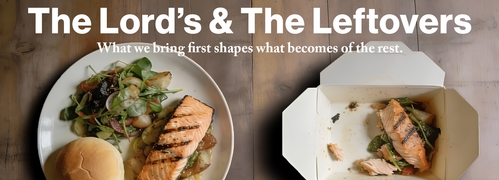
Group Discussion Guide
The Lord's and The Leftovers - Part 1
This guide is designed to help your group create a space for genuine connection and conversation within your discussion time. Don't feel pressured to address every question each week. Instead, allow the Holy Spirit to guide you as you lead your group in uncovering what God intends to communicate during your time together.
This guide comprises three sections: Loving, Learning, and Living. Each section aims to steer your conversation towards meaningful discussions about spiritual growth as individuals and as members of the body of Christ.
This guide comprises three sections: Loving, Learning, and Living. Each section aims to steer your conversation towards meaningful discussions about spiritual growth as individuals and as members of the body of Christ.
LOVING
First moments together as a group to connect and pray (approx. 10-15 min).
Open with prayer and invite God to be part of your conversation and relationship.
- How have you seen God at work in your life since the last time we met?
- What has been one high and one low since the last time we met?
- How did you do with living out what we talked about last time we met?
Open with prayer and invite God to be part of your conversation and relationship.
LEARNING
The majority of the group discussion is devoted to open dialogue, reflecting on God’s Word and its personal application to each of our lives (approx. 60-75 min).
Scripture References from Message: Genesis 4:3-9; Matthew 6:21
Big Idea from Message: God doesn’t want your money, He wants your heart | What’s in our hands shapes our hearts
Scripture References from Message: Genesis 4:3-9; Matthew 6:21
Big Idea from Message: God doesn’t want your money, He wants your heart | What’s in our hands shapes our hearts
When you hear a sermon about money or generosity, what’s your honest first reaction—curiosity, tension, resistance, relief, something else?
The sermon asked: “Is God first in my finances, or just included somewhere?” What do you think the difference looks like in real life—not theoretically, but practically?
Have you ever realized God was included in your decisions, but not actually first? What helped you notice that?
Read about Cain and Abel in Genesis 4:3-7. God had regard for Abel’s offering, but not Cain’s. God disregarded Cain’s gift, not Cain himself. What stands out to you about that difference? Why do you think that distinction matters—especially when we talk about generosity or obedience?
The first big idea was “God doesn’t want your money, He wants your heart.” Why do you think money is such a powerful indicator of what has our heart?
The message contrasted firstfruits and leftovers, giving and keeping. Giving often flows from trust, while keeping often flows from fear. Which fears tend to drive our financial decisions—fear of lack, scarcity, loss of control, or something else?
The 2nd big idea was that “What’s in our hands shapes our hearts”. How have responsibility, resources, or even limitations shaped your faith over time? In what ways do you think generosity actually forms us, rather than just helps others?
The sermon asked: “Is God first in my finances, or just included somewhere?” What do you think the difference looks like in real life—not theoretically, but practically?
Have you ever realized God was included in your decisions, but not actually first? What helped you notice that?
Read about Cain and Abel in Genesis 4:3-7. God had regard for Abel’s offering, but not Cain’s. God disregarded Cain’s gift, not Cain himself. What stands out to you about that difference? Why do you think that distinction matters—especially when we talk about generosity or obedience?
The first big idea was “God doesn’t want your money, He wants your heart.” Why do you think money is such a powerful indicator of what has our heart?
The message contrasted firstfruits and leftovers, giving and keeping. Giving often flows from trust, while keeping often flows from fear. Which fears tend to drive our financial decisions—fear of lack, scarcity, loss of control, or something else?
The 2nd big idea was that “What’s in our hands shapes our hearts”. How have responsibility, resources, or even limitations shaped your faith over time? In what ways do you think generosity actually forms us, rather than just helps others?
LIVING
The challenge for the week ahead is to grow in our faith and lovingly hold each other accountable through the community.
The challenge for this week is to audit your finances as a heart check, not a math exercise. What would make that kind of audit feel helpful instead of shame-inducing? What might it look like to take one small step toward putting God first rather than last or “somewhere”? Where do you sense God inviting you into greater trust—not just with money, but with your life as a whole?
The challenge for this week is to audit your finances as a heart check, not a math exercise. What would make that kind of audit feel helpful instead of shame-inducing? What might it look like to take one small step toward putting God first rather than last or “somewhere”? Where do you sense God inviting you into greater trust—not just with money, but with your life as a whole?